
Tile Slip Coefficient – Why Safety Depends on It
Slippery kitchen floors or a rainy Yorkshire patio can quickly turn a beautiful space into a safety concern. Homeowners in North Yorkshire planning a tiling project face more than just picking colours, since the tile slip coefficient plays a key role in preventing trips and falls. By understanding how surface materials and certified slip ratings impact real-world usage, you will gain practical confidence in selecting tiles that provide both style and reliable safety for your family.
Table of Contents
- Tile Slip Coefficient Explained And Common Myths
- Key Slip Ratings: R9–R13 And PTV Standards
- Main Testing Methods: Ramp And Pendulum Tests
- Legal Standards And UK Safety Regulations
- How To Choose Safe Tiles For Every Space
Key Takeaways
| Point | Details |
|---|---|
| Understanding Slip Resistance | The tile slip coefficient is essential for safety, quantifying the friction between tiled surfaces and footwear to prevent accidents. |
| Importance of Testing | Professional slip resistance testing, including R ratings and Pendulum Test Values (PTV), is crucial for choosing safe tiles based on intended use. |
| Legislation Compliance | UK safety regulations mandate risk assessments and documented slip resistance evaluations for workplaces, ensuring adequate protection against slips. |
| Tile Selection Strategy | Selecting tiles should account for environmental conditions, with higher slip resistance recommended for areas prone to moisture and high foot traffic. |
Tile Slip Coefficient Explained and Common Myths
Understanding the tile slip coefficient involves more than simply memorising numbers - it requires comprehending how surface characteristics interact with safety. Slip resistance isn’t just a technical measurement, but a critical factor in preventing accidents in both residential and commercial environments.
The slip coefficient represents the friction between a tile surface and footwear, quantifying how likely someone is to lose their footing. UK slip resistance guidelines demonstrate that this measurement isn’t arbitrary but a precise scientific assessment. Different surfaces generate varying levels of friction, which means not all tiles perform equally in preventing slips and falls.
Common myths about slip resistance often mislead homeowners. Many believe that smooth tiles are inherently dangerous, but texture isn’t the only factor. Surface material, microscopic topography, and environmental conditions like moisture significantly influence slip potential. Materials science research reveals that slip happens at a microscopic level, involving complex interactions between material structures and applied forces.
When selecting tiles, understanding slip coefficients helps make informed safety choices. Professional testing provides standardised measurements that go beyond visual appearance, offering concrete data about a tile’s performance. Factors like surface roughness, tile material, and intended usage all contribute to determining an appropriate slip coefficient for different environments.
Pro tip: Always request certified slip resistance test results when purchasing tiles for areas with potential moisture or high foot traffic.
Key Slip Ratings: R9–R13 and PTV Standards
Tile slip ratings represent a critical safety measurement system that helps homeowners and professionals understand the potential slip risk of different surfaces. The R rating and Pendulum Test Value (PTV) are two primary methods used to quantify slip resistance, each providing unique insights into a tile’s safety performance.
UK slip resistance guidelines explain that R ratings range from R9 to R13, with each level indicating the surface’s performance on an inclined ramp under controlled conditions. R9 represents the lowest slip resistance, while R13 indicates the highest level of safety in wet or oily environments. These ratings are determined through standardised testing that simulates real-world walking conditions, measuring how effectively a surface prevents slipping.
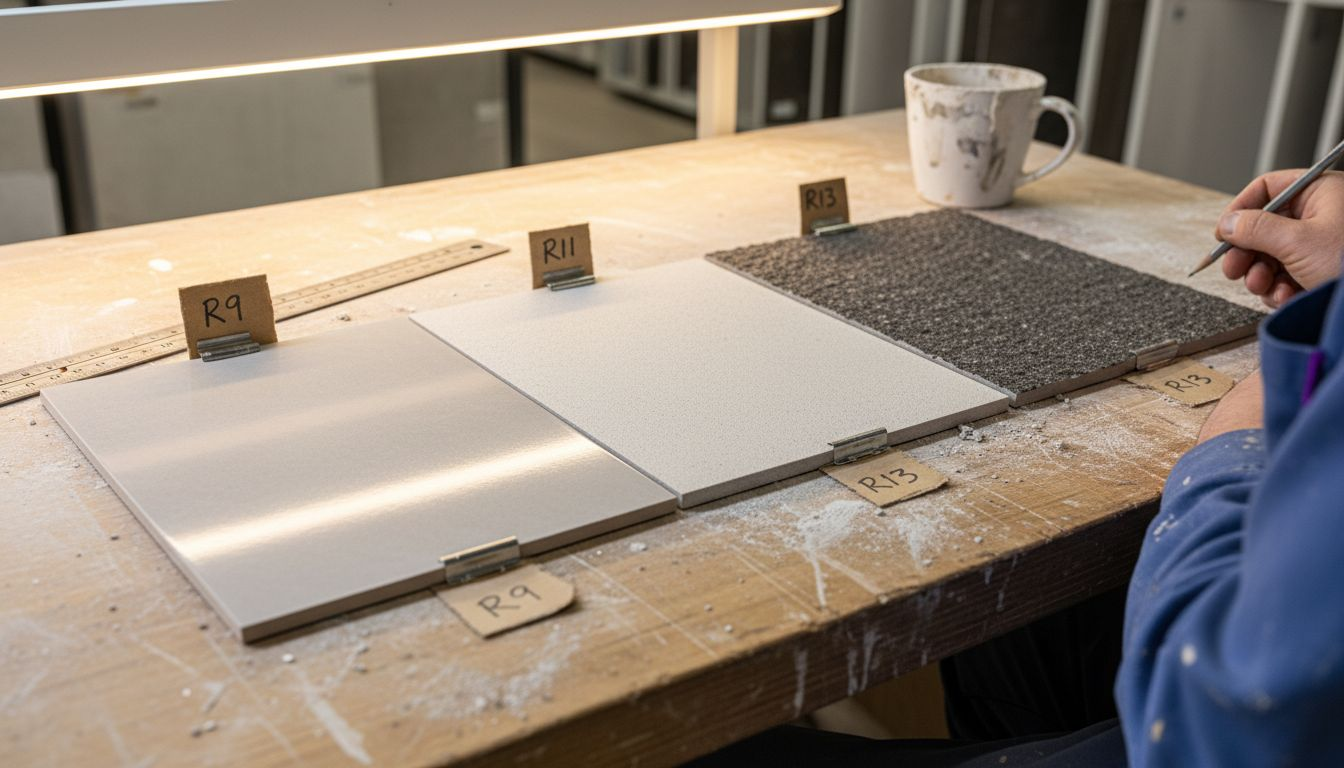
Interestingly, the slip resistance measurement is not straightforward. Slip resistance testing reveals that different testing methods provide complementary information. The R rating focuses on angle of slip on an oily ramp, while the Pendulum Test Value (PTV) measures dynamic slip resistance on wet surfaces. This means that a tile might perform differently under various conditions, making it crucial to consider multiple testing standards when evaluating safety.
For practical application, here’s a breakdown of R ratings:
- R9: Minimal slip resistance (0-10 degree angle)
- R10: Low slip resistance (10-19 degree angle)
- R11: Moderate slip resistance (19-27 degree angle)
- R12: High slip resistance (27-35 degree angle)
- R13: Maximum slip resistance (over 35 degree angle)
Pro tip: Always request comprehensive slip resistance documentation that includes both R ratings and PTV values to ensure maximum safety in your tiling project.
Main Testing Methods: Ramp and Pendulum Tests
Slip resistance testing involves sophisticated methods designed to predict potential safety risks in different environments. Two primary techniques dominate the field: the ramp test and the pendulum test, each offering unique insights into a surface’s slip characteristics and safety performance.
UK slip resistance standards reveal that the ramp test involves using a contaminated inclined surface with standardised footwear to evaluate slip potential. In this method, researchers gradually increase the surface angle until a test subject loses footing, providing a quantitative measure of slip resistance. The angle at which slipping occurs determines the critical R rating, ranging from R9 to R13, which helps professionals assess safety across different environments.
Pendulum testing represents another crucial assessment technique, preferred by the Health and Safety Executive for evaluating pedestrian slip risk. This method simulates a walking heel strike by swinging a rubber slider across a floor surface, measuring the resistance encountered. The test produces Pendulum Test Values (PTVs), which indicate the likelihood of slipping under wet conditions. What makes this method particularly valuable is its dynamic approach, capturing real-world movement characteristics more accurately than static measurements.
Key differences between the two testing methods include:
Here is a comparison of ramp and pendulum slip resistance testing methods for quick reference:
| Testing Method | Measurement Type | Key Tool Used | Main Application |
|---|---|---|---|
| Ramp Test | Static (angle-based) | Inclined ramp, shoes | Oil, industrial settings |
| Pendulum Test | Dynamic (force-based) | Pendulum device | Wet conditions, public walkways |
- Ramp Test: Static measurement using angle of slip
- Pendulum Test: Dynamic measurement simulating heel strike
- Ramp Test: Uses standardised footwear
- Pendulum Test: Uses a rubber slider
- Ramp Test: Determines R ratings
- Pendulum Test: Produces Pendulum Test Values (PTVs)
Pro tip: Always request comprehensive testing results that include both ramp and pendulum test measurements to get a complete picture of a surface’s slip resistance.
Legal Standards and UK Safety Regulations
Safety regulations surrounding floor slip resistance represent a critical aspect of workplace and public space design in the United Kingdom. These standards are not merely recommendations, but legally enforceable guidelines designed to protect individuals from potential accidents and injuries.
Health and Safety Executive regulations mandate that floors in workplaces must be suitable, safe, and demonstrate adequate slip resistance based on specific activity environments. The Workplace (Health, Safety and Welfare) Regulations 1992 establish clear requirements for floor surfaces, compelling employers and property managers to systematically assess and mitigate slip risks through rigorous testing and appropriate surface selection.
Under UK law, slip resistance is evaluated using standardised testing methods that provide objective measurements of surface safety. These assessments typically involve sophisticated techniques like pendulum testing, which simulates real-world walking conditions and generates precise Pendulum Test Values (PTVs). Technical guidance from safety regulators emphasises the importance of using reliable, scientifically validated methods to interpret slip resistance data and ensure compliance with legal standards.
Key legal considerations for slip resistance include:
- Mandatory risk assessments for floor surfaces
- Requirement for documented slip resistance testing
- Specific standards for different workplace environments
- Legal liability for inadequate safety measures
- Periodic review and maintenance of floor safety
Pro tip: Maintain comprehensive documentation of slip resistance tests and regular safety assessments to demonstrate proactive compliance with UK health and safety regulations.
How to Choose Safe Tiles for Every Space
Selecting the right tiles involves more than aesthetic considerations - safety must be a primary factor. Different spaces demand unique slip resistance characteristics, making it crucial to understand how tile selection impacts pedestrian safety across various environments.
UK slip resistance guidelines provide comprehensive insights into selecting appropriate tiles based on specific environmental conditions. The selection process requires careful evaluation of factors like moisture levels, foot traffic intensity, and potential contamination risks. For instance, bathroom and kitchen tiles need higher slip resistance compared to living room surfaces due to increased exposure to water and potential spillage.
Specific spaces demand targeted tile selection strategies. Outdoor areas require tiles with robust R11 or R12 ratings to handle wet conditions, while commercial spaces like restaurants need tiles capable of withstanding frequent cleaning and potential grease exposure. Residential areas can typically use tiles with moderate slip resistance (R9-R10), balancing safety and aesthetic preferences. Professional tiling guidance emphasises the importance of considering surface texture, maintenance requirements, and long-term performance when making selections.
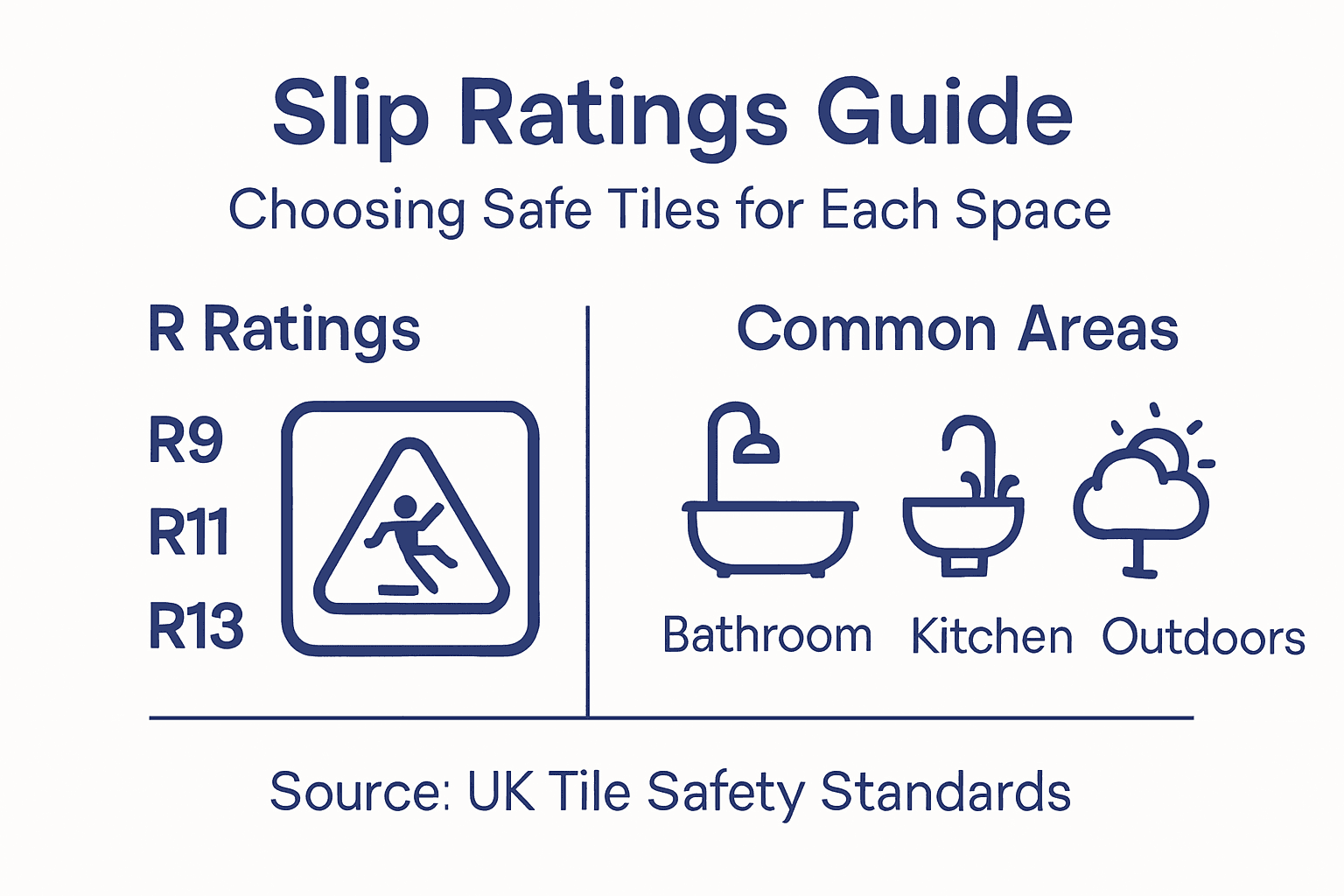
This summary table highlights suitable tile slip ratings for different environments:
| Space Type | Recommended R Rating | Typical Risk Factor |
|---|---|---|
| Bathroom/Kitchen | R11–R12 | High moisture |
| Living Room | R9–R10 | Low moisture |
| Outdoor Patio | R11–R12 | Rain, weather exposure |
| Commercial Kitchen | R12–R13 | Grease, frequent cleaning |
Key considerations for safe tile selection include:
- Evaluate slip resistance ratings (R9-R13)
- Consider environmental conditions
- Assess potential moisture exposure
- Match tile texture to specific space usage
- Factor in maintenance and cleaning requirements
- Review pendulum test values (PTV)
Pro tip: Always request a professional slip resistance assessment for high-risk areas like commercial kitchens, wet rooms, and public spaces to ensure maximum safety.
Prioritise Safety with Tiles That Meet Your Slip Resistance Needs
Understanding the importance of the tile slip coefficient is essential for preventing slips and falls in any space. Whether you are renovating a bathroom, upgrading an outdoor patio, or designing a commercial kitchen, selecting tiles with the right slip resistance rating safeguards every step. At Vividotiles.co.uk, we offer a wide selection of premium tiles including porcelain, natural stone and outdoor options that combine style with proven safety ratings like R11 and above for high-risk areas. We understand your need for trustworthy, tested materials that meet UK safety standards and legal regulations.

Explore our range now at Vividotiles to find tiles specially chosen to balance texture, durability and slip coefficient. With free UK delivery, budget-friendly prices and expert advice available, you can confidently choose tiles that protect your family or customers without compromising on design. Visit our website or come see our new showroom in Harrogate to experience first-hand how our collections support your safety and style goals today.
Frequently Asked Questions
What is the tile slip coefficient and why is it important?
The tile slip coefficient measures the friction between a tile surface and footwear, quantifying the likelihood of slipping. Understanding this coefficient is crucial for preventing accidents in both residential and commercial settings.
How are slip resistance ratings determined for tiles?
Slip resistance ratings are derived from standardised testing methods, such as the ramp test, which assesses how effectively a surface prevents slipping under controlled conditions. The ratings range from R9 to R13, indicating levels of slip resistance from minimal to maximum.
What are the differences between R ratings and Pendulum Test Values (PTV)?
R ratings evaluate slip resistance based on the angle of slip on an oily ramp, while Pendulum Test Values measure dynamic slip resistance in wet conditions. Both provide essential insights into a tile’s safety performance under different circumstances.
How do environmental conditions affect tile slip resistance?
Environmental factors, such as moisture levels and surface contamination, significantly influence tile slip resistance. Tiles selected for spaces with high moisture or grease exposure require higher slip resistance ratings to ensure safety and prevent accidents.